
Banggai Briefs: Poponding
Location: Ds. Bonepuso, Kec. Bulagi Selatan, Kep. Kepulauan Banggai (Banggai Islands Regency), Sulawesi Tengah (Central Sulawesi)
Ds. Alani, Kec. Buko Selatan, Banggai Islands Regency, Central Sulawesi
Sound: Poponding (also called tambiling or tulumbe)
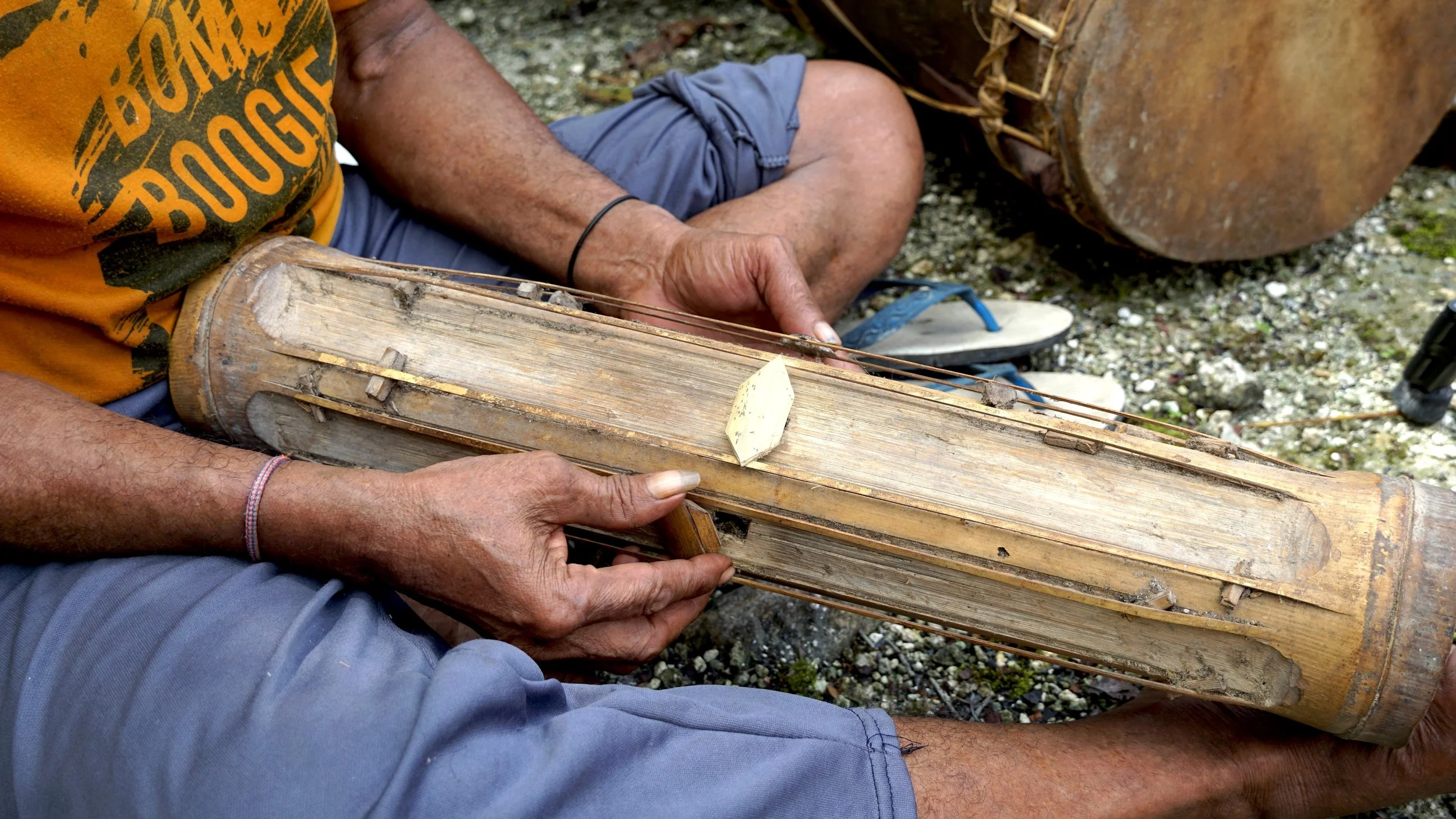
Poponding is a bamboo tube zither played by the Banggai and Seasea people of Central Sulawesi’s Banggai Archipelago. All across Indonesia, tube zithers are associated with gong music, with the enharmonic clang of gongs finding an unlikely twin in the plucked tones of bamboo strings. Likewise in Banggai, the poponding is a batong gong ensemble in miniature.
While batong remains a crucial part of Banggai ritual life, the poponding tradition has nearly disappeared: I managed to track down only two elderly players, Pak Darius Kapulian and Pak Lamani Baalut. Living in two quite different villages in the culturally rich southwestern wing of Peling Island, both men nonetheless shared quite similar stories and tunes with me.
To make the poponding, a piece of bamboo (common bamboo, peling, or a special variety called awo) is cut near its natural nodes (potunggup.) The skin of the bamboo is sliced and raised with bridges (pasamai) to become seven strings. Three pairs of strings are in turn each joined together by a floating bridge (langgopo) which adds mass and thus a bassy depth to some of the strings when plucked.
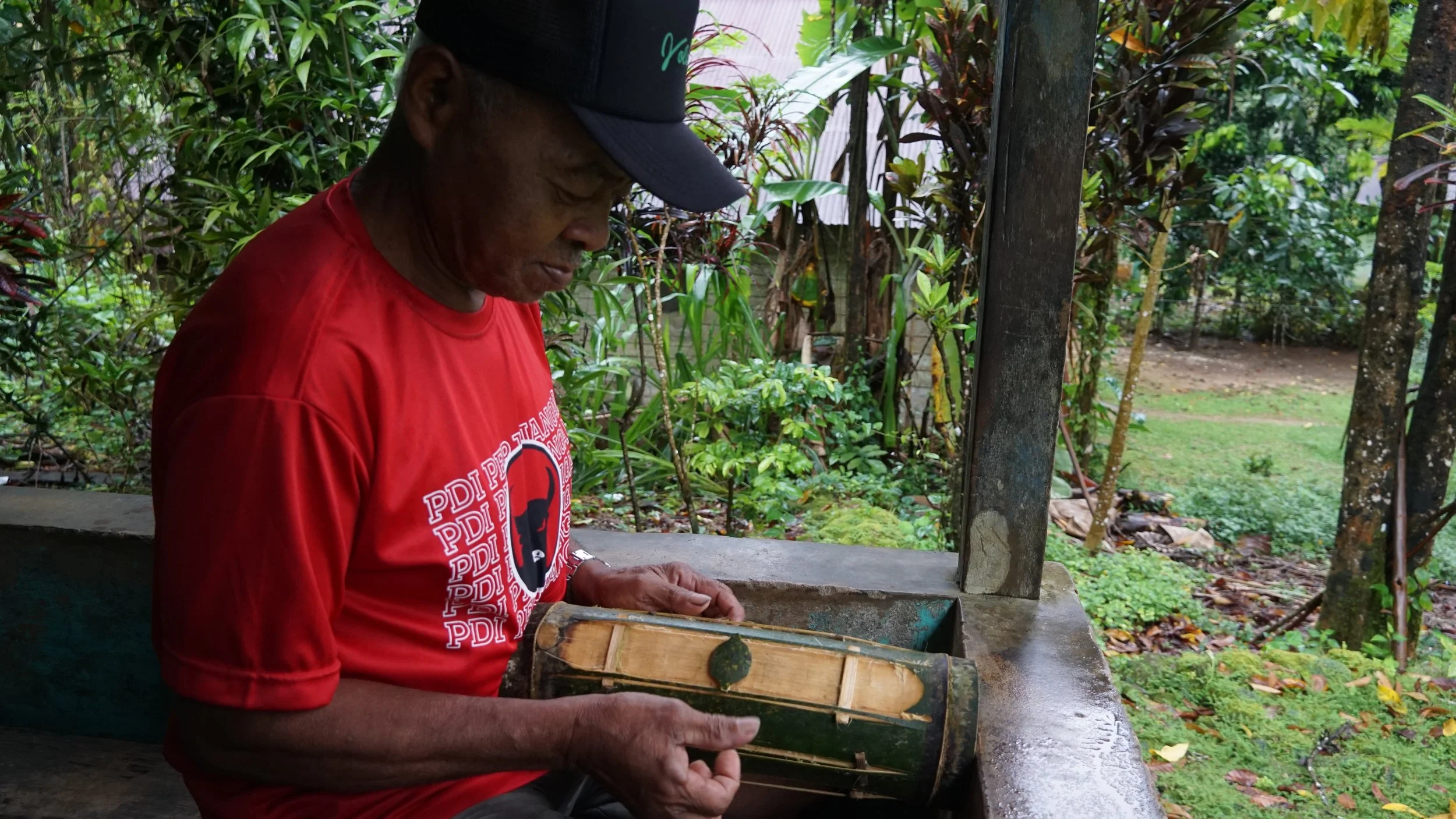
People rarely make these incredible instruments anymore; in Alani, Pak Darius actually made one fresh out of still-green bamboo on word of my arrival, while Pak Lamani pulled a dusty one out of storage that he’d made for a regional arts festival years back. The fact is that these instruments once filled a unique niche in Banggai life: both men told me that the instrument was played for entertainment when living in the pondok, bamboo shacks in the interior mountains of Banggai where folks grow yam, ubi. Far from home and with little to entertain themselves, they would release the stresses of a long day by playing poponding for family members, or simply for themselves.
Nowadays, people rarely live for so long out at the pondok, and other attractions from radio to smartphones provide plenty of distraction. The poponding tradition, therefore, lies dormant, trotted out only for government-funded arts festivals and for nosy ethnomusicologists like me.
It’s a shame, as the playing of poponding is a true wonder of musical multi-tasking, with each musical part from the batong repertoire finding its analogue in the humble tube zither. “Batong takes five or six men, but with poponding you only need one!” exclaimed Pak Lamani’s friends as I marveled at his playing.
Both players approached the instrument in similar ways: strings joined by those floating bridges were plucked to replicate the rhythms of the larger hanging gongs of the batong ensemble, poduwol and sinapit, while a single string was plucked to achieve the sound of the smaller hand-held gong, tutung. Much of the rhythmic variation, meanwhile, is expressed by carefully tapping another of the floating bridges against the body of the zither, the sharp rap imitating leles, a rhythm beat out on a gas canister or the rim of a gong, and ghost notes filling in the thud of the bobolon drum.
The rhythmic patterns were plucked straight from batong: both men played the rhythm that accompanies the war dance balatindak (different dialects made themselves known: Pak Lamani called this rhythm Kukubet, while Pak Darius called it Kalibatang), and both showed me their version of Tabua, the rhythm that accompanies common dances like the baselendang scarf dance. Pak Lamani had a few other tricks up his sleeve, also playing not only Balala (also called Baaya, after the vocals that often accompany it) but my favorite, the loping Baganjar. When played for batong, this rhythm drives on the traditional martial arts sparring of kuntau, also called ganjar, and its distinctive six beat rhythm is echoed across other martial arts percussion traditions across Indonesia, from ganrang Konjo in South Sulawesi to gendang sarunai in West Sumatra.
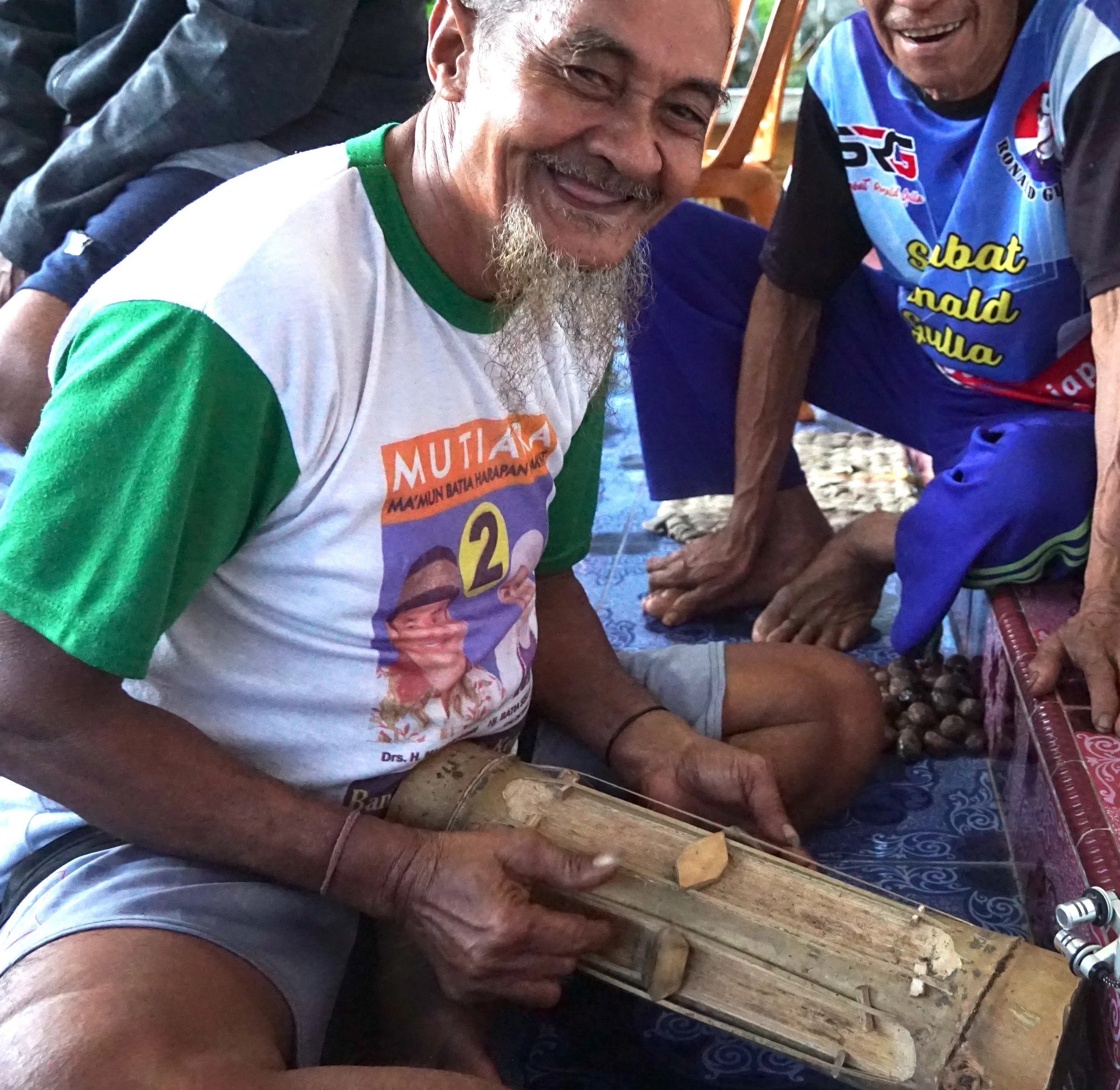
As Pak Lamani shared these pieces with me on the porch of his home in Bonepuso, his friends sat around and listened with a smile, clearly feeling nostalgic. “On rainy days and quiet nights, we’d play like this!” I can’t help but join them in romantically imagining those nights when a length of bamboo conjured phantom gong ensembles in the dark of the pondok. Those nights are past, they seemed to say, but the songs remain.
+++
Special thanks to Pak Lamani Baalut, Pak Darius Kapulian, Pak Aslan in Bone Puso and Kak Kalpin in Alani for making this post possible.